Why individual cells matter
A lithium pack is only as strong as its weakest cell. The whole pack stops charging when the highest cell hits its limit, and it stops discharging when the lowest cell bottoms out. That means one drifting cell shrinks the usable energy of the entire battery, even when the others are fine. BAT-BMS shows you each cell so you can catch that drift early.
What healthy voltage looks like
The exact numbers depend on chemistry, but the shape is the same. At rest, a healthy pack has all cells within a few millivolts of each other. At the top of charge, they converge again as the BMS tops off the laggards. The range you care about: for LiFePO4, cells rest around 3.2 to 3.3 V and hit 3.65 V at full. For common lithium-ion, expect 3.6 to 3.7 V resting and 4.2 V full. If you are unsure of your chemistry, the supported batteries guide lists the common ones.
Reading the spread
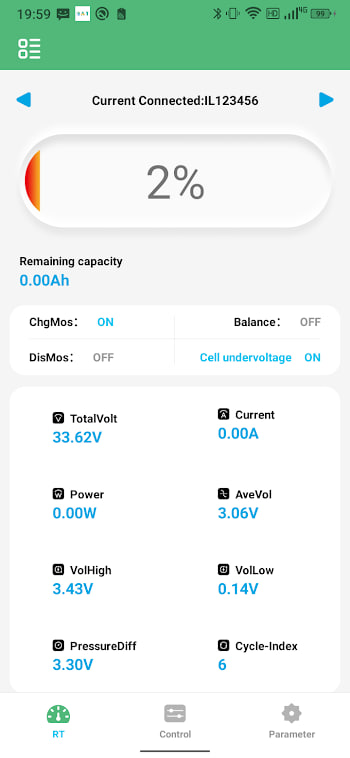
In the cell view, BAT-BMS lays out a bar per cell. The bars should be nearly level. If one bar pokes above the rest at the top of charge, that cell is either fuller or being under-balanced. If one sinks well below at the bottom of discharge, that cell has less capacity — the classic sign of aging.
The spread is most telling at full charge and near empty. Mid-pack readings are noisy and less useful for diagnosing problems.
How balancing works
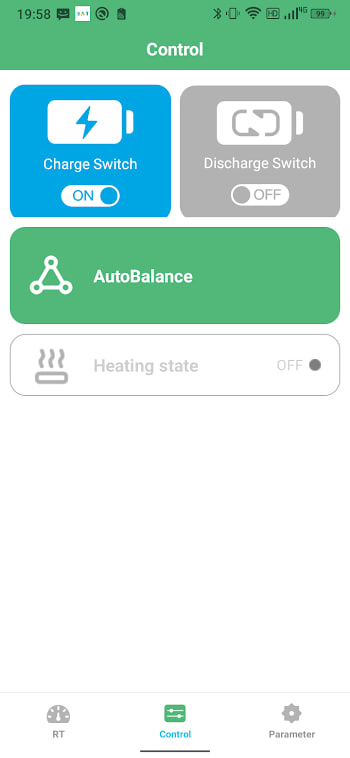
When one cell runs ahead, the BMS bleeds a small current off it through a resistor so the others can catch up. This is balancing, and it happens automatically near the top of charge. In BAT-BMS you can see which cells are actively being bled. If balancing never seems to engage and the spread keeps growing, you may have a cell that is too far gone for the balancer to keep up — a sign to investigate further.
Spotting the weak cell
The weak cell reveals itself in two places: it drops fastest during discharge, and it rises fastest during charge. Note its position in the string. If the same cell misbehaves over multiple cycles, that is the one to replace or investigate — not the whole pack.
What to do about drift
Small drift is normal and the balancer handles it. Large, persistent drift is not. Give the pack a slow full charge and let it balance for a few hours. If the spread still will not close, the suspect cell likely needs attention. Avoid the temptation to keep pushing a badly unbalanced pack; that is how cells get damaged.