Why a battery needs a brain
A single lithium cell is simple: it gives you voltage, you use it, you charge it. The moment you wire cells into a pack, things get complicated. Cells are never perfectly matched, so they drift apart over cycles. Charge one too far and it degrades; discharge one too low and it dies. A battery management system is the brain that watches every cell and steps in before any of that happens. BAT-BMS is simply the window into that brain.
Voltage, in plain terms
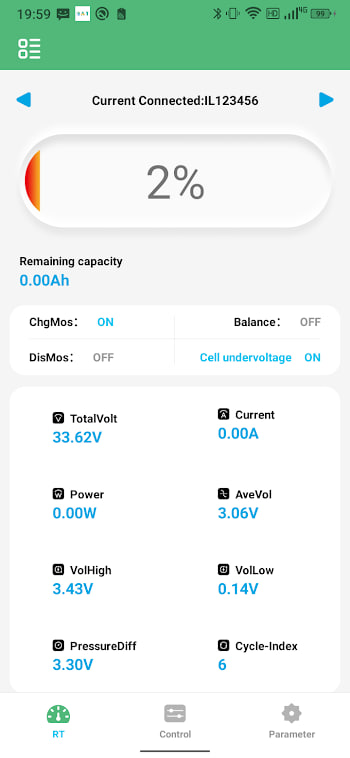
Voltage is electrical pressure. A lithium cell has a resting voltage that tells you roughly how full it is. For LiFePO4, that sits around 3.2 to 3.3 V at half charge and about 3.65 V at full. For common lithium-ion, expect 3.6 to 3.7 V resting and 4.2 V full. A whole pack is cells in series, so a 4S LiFePO4 pack reads roughly 12.8 V nominal. Multiply per-cell voltage by the series count and you get the pack voltage.
Capacity and current
Capacity is how much energy a pack holds, measured in amp-hours. A 100 Ah pack can in theory deliver 100 amps for one hour, or 10 amps for ten hours. Current is the flow right now — how fast energy moves in or out. BAT-BMS shows live current so you can see whether the pack is charging, discharging, or resting, and how hard.
Series and parallel
Cells in series add voltage; cells in parallel add capacity. A pack labelled 4S2P has four cells in series for voltage and two in parallel for capacity. The BMS watches each series group as a unit. Understanding your configuration helps you read the cell view correctly — the number of bars equals your series count.
Why balancing matters
No two cells stay identical forever. Over cycles, some run slightly ahead or behind. Without balancing, the gap widens until the highest cell trips over-voltage and stops the charge while the rest are still hungry. The BMS bleeds a little energy from the fullest cells near the top of charge so the others can catch up. That keeps the pack balanced and its full capacity usable.
What the BMS protects against
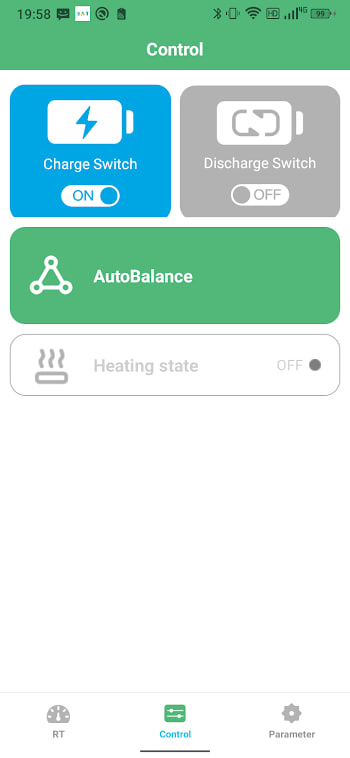
The BMS is a guard rail. It cuts charge when a cell goes too high, cuts discharge when the pack goes too low, limits current in both directions, and watches temperature. These are the same flags you see in BAT-BMS. The app does not invent them — it shows you the safety logic the hardware is already running. Read the error codes guide to learn what each one means.