What "battery health" really means
People throw the phrase around as if it were a single number. It is not. When you ask whether a pack is healthy, you are really asking three questions: how much capacity it still holds, how evenly the cells behave, and how it responds under load. BAT-BMS hands you the raw material to answer all three, but it helps to know what you are looking at.
State of charge, the easy number
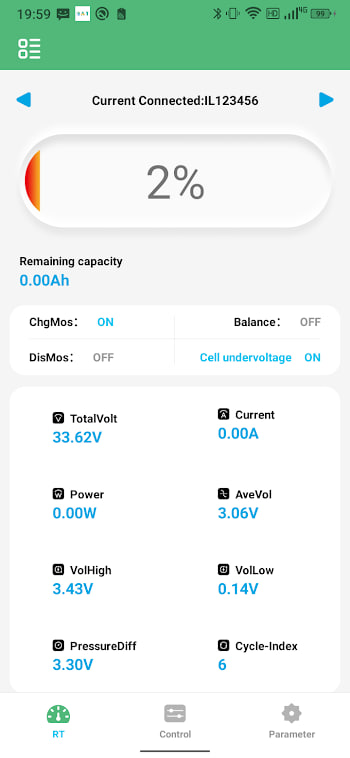
State of charge is the percentage everyone understands. It tells you how full the pack is right now, not how healthy it is. A pack can read 100% and still be on its last legs if the capacity has collapsed. Treat state of charge as a snapshot, not a verdict.
Real capacity vs nameplate
The honest measure of health is how many amp-hours the pack can actually deliver compared to what it claimed when new. BAT-BMS will not run a full lab discharge for you, but it gives you the pieces. Watch the current and the state of charge together over a discharge: if state of charge falls far faster than the nameplate suggests, capacity has dropped. The battery tips guide has habits that slow that decline.
Cell spread is the early warning
This is the one to watch. If all your cells read within a handful of millivolts at rest and at the top of charge, the pack is balanced and content. When one or two cells start drifting wide of the rest, that is the earliest sign of trouble — usually a cell aging faster than its neighbours. The cell voltage guide shows you how to read the spread and when to act.
Internal resistance, the quiet signal
As cells age, their internal resistance climbs. You cannot see resistance directly in BAT-BMS on every module, but you can infer it: a cell whose voltage sags much more than the others under load, then bounces back, is the one with rising resistance. Note which cell it is. Over months, that sag pattern is a better health signal than any single reading.
Cycles and age
Lithium packs are rated for a certain number of charge cycles, and they age even when sitting unused. If you know roughly how old the pack is and how hard it has worked, you can set sensible expectations. A five-year-old pack that has cycled daily will behave differently from a two-year-old pack used occasionally, regardless of what the app shows on a good day.